Machine Learning Researcher — XuLab & Brown University
Feb 2025 – Present
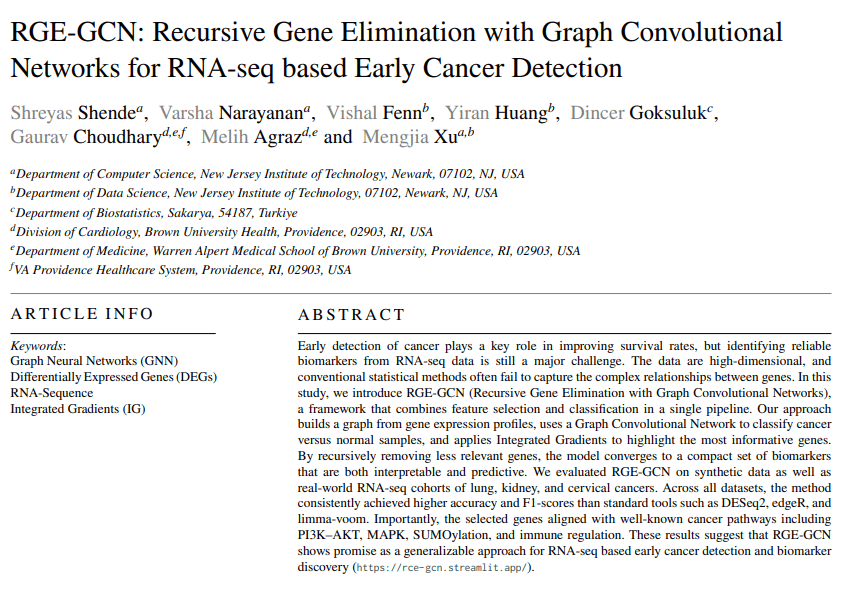

As a Machine Learning Researcher at Brown University’s XuLab, I collaborated with a team of researchers to tackle the critical challenge of early cancer detection using high-dimensional RNA-seq data. Our primary objective was to address the “large p, small n” problem—where genetic features vastly outnumber patient samples—which often hampers the performance of traditional machine learning models. To solve this, I spearheaded the development of RGE-GCN (Recursive Gene Elimination with Graph Convolutional Networks), a novel deep learning framework. By shifting the paradigm from standard gene-interaction models to constructing sample-sample graphs based on Pearson Correlation Coefficients, we were able to capture latent community structures among patients and identify robust biomarkers more effectively than existing methods.
The success of this project relied heavily on our collaborative efforts to rigorously validate the model against established biological standards. Working closely with my colleagues, we benchmarked RGE-GCN against industry-standard differential expression tools such as DESeq2 and edgeR, demonstrating that our approach consistently achieved superior accuracy across lung, kidney, and cervical cancer datasets. Beyond performance, we prioritized model interpretability; I integrated Explainable AI techniques (Integrated Gradients) to ensure that the biomarkers selected by our model were biologically relevant—a critical step for gaining clinical trust.
We documented these findings in our research paper, “RGE-GCN: Recursive Gene Elimination with Graph Convolutional Networks for RNA-seq Based Early Cancer Detection”, which is available on arXiv here.
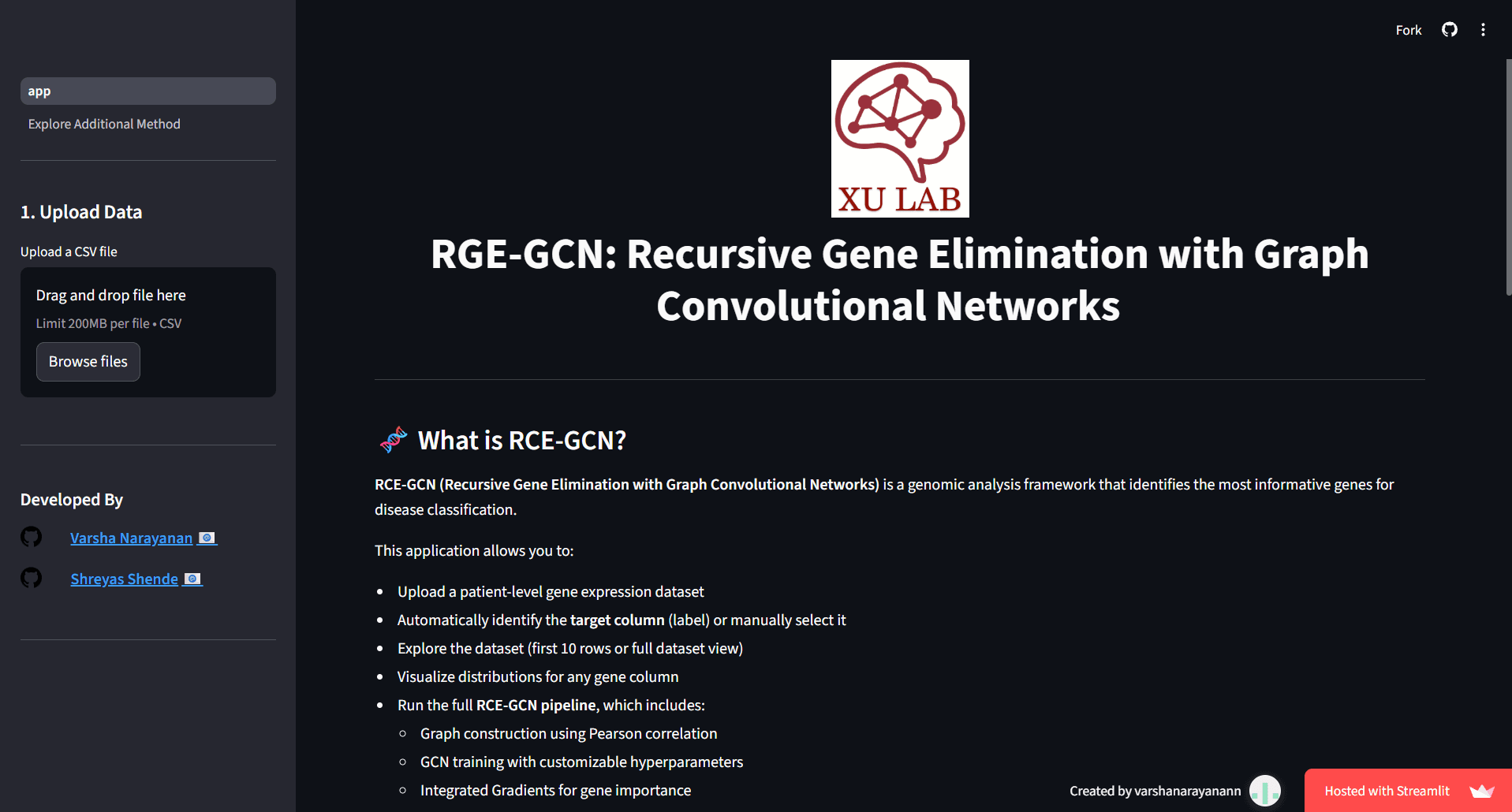
To ensure our research translated into a practical tool for the broader scientific community, I led the full-stack engineering of a user-friendly web interface. I built and deployed an interactive application using Streamlit that allows clinicians and biologists to upload their own datasets, run our pipeline, and visualize gene elimination processes in real time—without requiring coding expertise. This tool bridges the gap between complex algorithmic theory and actionable medical insights and can be accessed here.